Cooper Health pilots Microsoft’s Dragon Copilot ambient AI tool with nurses
Becker’s Hospital Review, September 28, 2026
Cooper University Health Care is piloting Microsoft’s Dragon Copilot with nurses on a single unit at Cooper University Hospital in Camden, New Jersey. With patient consent, nurses start an ambient recording during care, and the tool drafts structured EHR documentation from the conversation and spoken observations, which nurses then review and approve before it enters the record. Cooper already runs more than 1,300 Dragon Copilot licenses for physicians and advanced practice providers, and says it will evaluate documentation time savings, accuracy, and nurse satisfaction before deciding whether to expand the pilot.Trump administration launches AI powered “digital front door” for the federal government, including Medicare enrollment
Healthcare IT News, September 29, 2026
President Trump signed an executive order launching America.gov, described as “the unified digital front door to the federal government,” built on Google’s Gemini and Grok large language models drawing on roughly 29,000 government websites. CMS Administrator Dr. Mehmet Oz said Medicare beneficiaries will soon be able to select and enroll in a plan through the chat interface, with the system pulling required information directly from the Social Security Administration, and fuller transaction capability planned for a 2027 phase two.McKinsey: AI could already perform the reasoning behind 16% to 22% of US outpatient care
Becker’s Hospital Review, September 28, 2026
A McKinsey analysis of 2024 commercial, Medicare, and Medicaid claims found AI could perform what it calls “discursive care,” reasoning and dialogue based work such as intake, triage, diagnosis, referrals, and follow-up that doesn’t require a hands-on exam, representing 16% to 22% of outpatient claims and 13% to 19% of outpatient spending, roughly 2 to 3 billion claims. McKinsey flagged deskilling as a key risk if clinicians lean on AI without deliberate practice, and said it expects rising overall care demand to offset workforce reduction.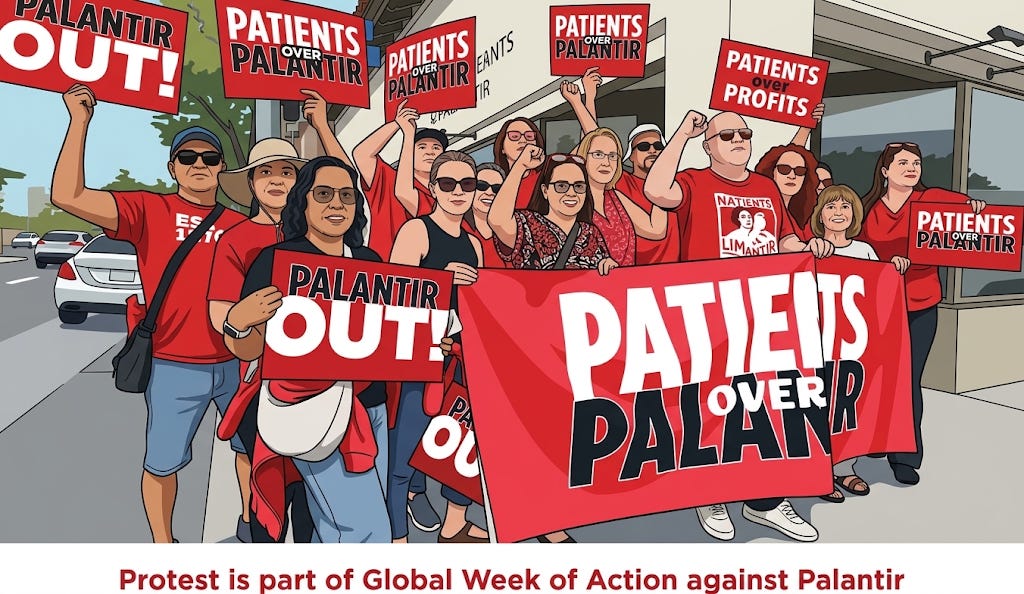
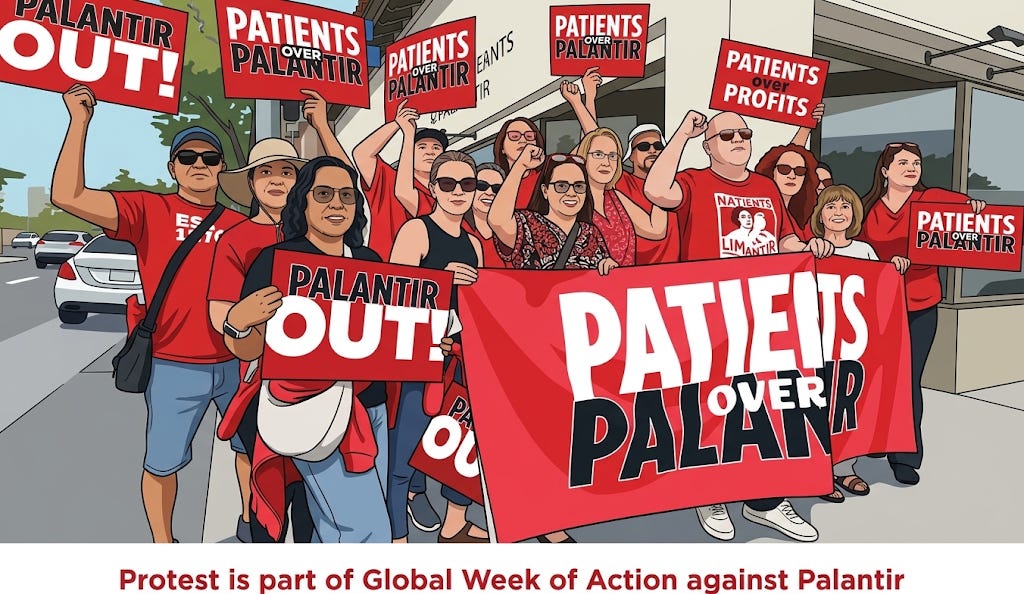
More than 1,000 nurses march on Palantir’s work with ICE as global week of action reaches its main event (4th appearance of this story; first covered in the September 26 digest, most recently referenced September 29)
National Nurses United, September 30, 2026
National Nurses United said more than 1,000 nurses and community allies planned to march today from Jessie Square to San Francisco’s ICE building at 1:30 p.m., the centerpiece of the “People vs. Palantir Global Week of Action” running September 28 to October 1. The union is demanding hospitals and government agencies cancel contracts with Palantir over its ELITE system, which nurses say uses improperly obtained Medicaid data to help identify people for immigration arrests. CNA/NNOC President Sandy Reding said “the violence and destruction unleashed by immigration agents and enabled by Palantir is a total violation of nursing values.”Suki details a “$379 encounter” model for point of care AI revenue cycle gains
Becker’s Hospital Review, September 29, 2026
Suki Chief Medical Officer Dr. Kevin Wang described capturing documentation with ambient AI during the clinical encounter itself, rather than fixing revenue cycle problems afterward, saying early results showed an average increase of $2,600 in captured revenue per clinician per month and a 48% reduction in amended encounters. Wang said revenue cycle work has traditionally focused on the steps before and after a visit while “the middle of the encounter was often glossed over.”IMO Health executive warns clinical AI pilots fail once real world data “loses meaning”
Healthcare IT News, September 29, 2026
IMO Health senior vice president Joseph Zabinski said many clinical AI pilots succeed on artificially clean demonstration data but falter in production because real clinical data contains “fragmentation, inconsistencies, gaps, drifts and loss of clinical context” that standard coding systems flatten, for example losing distinctions of severity, acuity, or suspected versus confirmed conditions. He warned generative AI can produce “fluent, plausible outputs” that mask underlying data problems, and recommended governance structures with multidisciplinary oversight spanning clinical, technical, compliance, and operational teams before scaling.OpenAI extends DevDay agent tools to ChatGPT for Healthcare customers
Becker’s Hospital Review, September 29, 2026
OpenAI said three tools unveiled among more than 20 announcements at its DevDay 2026 event are being extended to ChatGPT for Healthcare, the enterprise product it launched for hospitals and health systems in January: Dots, described as “always on agents that learn what matters to users,” off by default until a workspace administrator enables it; Codex in the Cloud, a remote coding agent; and support for plugin enabled Sites built inside a health system’s own workspace.
AI in Healthcare News September 30, 2026
1000+ nurses march against Palantir’s work with ICE; AI reasoning for outpatient care may not lead to workforce reduction