
Health system leaders continue to invest in artificial intelligence with the expectation that it will mitigate workforce strain and improve clinical efficiency. At the bedside, however, many implementations are producing the opposite effect. For inpatient nurses, these tools too often add verification requirements to already complex documentation workflows and introduce monitoring practices that can erode professional autonomy, psychological safety, and time available for direct patient care.
Clinical technology that creates more reconciliation work than it removes should not be characterized as innovation; it should be recognized and managed as an operational and patient-safety risk.
The Automation Paradox: Adding Technology Without Retiring Work
A persistent weakness in health IT strategy is the implementation of new technology without first decommissioning legacy processes. Inpatient nursing documentation is already distributed across multiple flowsheet bands, validation screens, and regulatory checklists. When predictive scores and generative drafts are layered onto these requirements rather than replacing them, the organization increases workload while preserving the underlying inefficiency.
The September 2026 Black Book Research survey of hospital nursing professionals illustrates the operational impact:
Task Accumulation: 63% of nurses reported that AI tools introduced net-new tasks without retiring existing requirements.
The Verification Burden: 58% spend added shift time resolving conflicting AI outputs, explaining exceptions, or answering downstream queries.
Workplace Surveillance: 65% report feeling individually watched or behaviorally tracked by AI systems.
Executive Misalignment: 73% believe health system leadership prioritizes financial return over clinical impact.
From an informatics perspective, an algorithm-generated draft or automated risk score may appear to complete a task. From a nursing practice perspective, it creates a new accountability step. Every automated assertion carries clinical and medicolegal implications. When a system identifies a care gap, flags deterioration, or pre-populates a handoff summary, the nurse must validate that output against the patient’s current condition, the plan of care, and the broader clinical context.
This validation is active clinical work. It requires concentration, judgment, and time, and organizations must account for it explicitly in staffing models, workflow design, and benefit-realization measures.
Unequal Design Priorities: Physician Efficiency and Nursing Oversight
Enterprise healthcare AI reflects a material difference in how physician and nursing workflows are designed, funded, and evaluated.
Physician-facing solutions have largely emphasized ambient documentation, including platforms such as Abridge, Knowtex, and Microsoft Dragon Copilot that capture clinical conversations and generate narrative notes. When these tools are narrowly designed to reduce documentation burden, adoption can be strong. The Veterans Affairs rollout of Knowtex reported an 88% sustained adoption rate across hundreds of facilities, underscoring the value of technology that measurably returns time to clinicians rather than expanding oversight of their work.
Nursing workflows, by contrast, are less often designed around cognitive relief. While the market offers dedicated clinical assistants for physicians, including specialized reasoning support for oncology tumor boards, nurses continue to encounter rigid worklists, automated time tracking, and risk algorithms that can increase alerts and documentation obligations without reducing core workload.
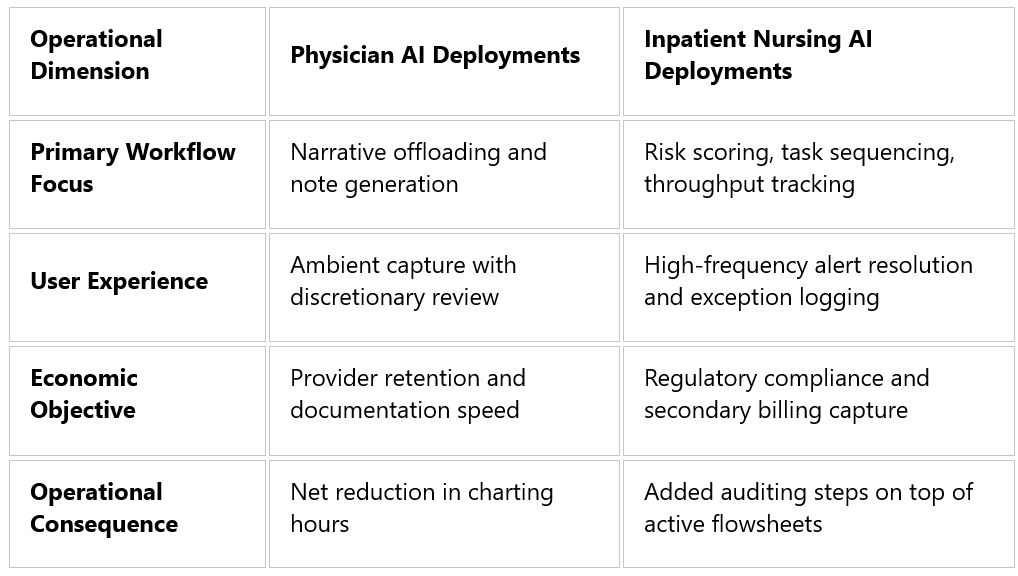
This asymmetry is reinforced by financial incentives. A recent Blue Cross Blue Shield Association analysis reported that AI-assisted inpatient billing tools added nearly $1 billion in costs across member plans over two years, largely by identifying secondary conditions in surgical cases without a corresponding increase in clinical treatment.
When algorithms are optimized to identify billable comorbidities, the resulting documentation burden frequently shifts to nursing and care management. Nurses must reconcile secondary diagnoses, respond to documentation queries, and align care plans with automated billing logic. The financial benefit may accrue to the revenue cycle, while the operational cost is absorbed by the clinical workforce.
Behavioral Monitoring and Its Impact on Safety Culture
Without transparent clinical governance, algorithmic oversight can evolve from decision support into workforce surveillance.
Bedside nursing is inherently dynamic and non-linear. Experienced nurses continuously reprioritize care in response to subtle changes in patient condition, family needs, resource availability, and emerging clinical risk. Yet many operational algorithms assess nursing performance through isolated timestamps, including medication-scanning intervals, vital-sign entry latency, and checklist completion. These measures may be easy to capture, but they do not reliably represent the quality, urgency, or complexity of nursing care.
The Black Book findings suggest that this design approach is already influencing clinical behavior:
52% of nurses have altered their documentation timing or care sequencing specifically to avoid negative algorithmic flags.
49% use system workarounds to bypass automated monitoring.
33% are less willing to report clinical uncertainty or near misses due to tracking concerns.
Only 29% are allowed to inspect the performance and behavioral data the system attributes to them.
When nurses alter the sequence of care to avoid an algorithmic flag, the organization has created a competing priority at the point of care. Any system that encourages documentation compliance ahead of an urgent clinical intervention introduces avoidable patient-safety risk.
Equally concerning, monitoring practices that discourage near-miss reporting are inconsistent with high-reliability principles. A mature safety culture depends on psychological safety, transparent reporting, and shared learning from system failures. Opaque scoring and punitive interpretations of workflow data instead promote defensive documentation and unreported workarounds.
Workforce Retention and the Development of Clinical Judgment
These workflow conditions carry direct workforce consequences. With 48% of surveyed nurses indicating that they would likely seek positions with less AI surveillance, inadequately governed technology should be treated as a measurable retention risk, not merely an adoption challenge.
The longer-term concern is the development of clinical judgment. Novice nurses build critical-thinking capacity by synthesizing trends across a shift, correlating laboratory findings with vital signs, and organizing priorities with guidance from experienced preceptors. These activities are not administrative residue; they are part of professional formation.
When automated systems dictate task sequencing or present conclusions without transparent rationale, novice clinicians may lose important opportunities to develop pattern recognition and independent clinical reasoning. At the same time, experienced nurses may be diverted from coaching and complex care to review algorithmic exceptions and document why their judgment appropriately differed from a software recommendation.
An Executive Standard for Responsible Clinical AI
Chief Information Officers, Chief Nursing Informatics Officers, Chief Nursing Officers, and clinical product leaders should establish a shared governance standard for AI deployment. No tool should enter the inpatient environment without meeting three non-negotiable operational requirements:
1. Required Workflow Decommissioning
Operational approval should require a documented plan to retire the work the technology is intended to replace. If an ambient or predictive system automates intake summaries or handoff reporting, the corresponding manual documentation requirements should be removed from the EHR build. A vendor that cannot demonstrate measurable workflow reduction has not established sufficient clinical value for deployment.
2. Separation of Clinical Decision Support From Workforce Performance Monitoring
Patient-care telemetry collected for clinical decision support should not be repurposed for individual productivity management. Algorithms designed to identify deterioration must not convert clinician response times into performance judgments without validated context and formal governance. Every clinician should have visibility into metrics attributed to them and access to a timely, documented process for correcting inaccurate or incomplete data.
3. Pre-Procurement Nursing and Clinical Architecture Review
Vendor demonstrations using static, idealized data do not reflect the demands of an active medical-surgical unit. Nursing informatics leaders, bedside nurses, and interprofessional clinical partners should lead evaluations before contracting. Testing should occur against realistic use cases, including handoffs, high-volume admission periods, rapid clinical deterioration, and emergency response, with explicit measures for time returned to care, alert burden, usability, equity, and safety.
The executive threshold should be clear: if a technology cannot support sound clinical judgment under operational stress while reducing net workload, it is not ready for the inpatient environment. Clinical AI must be accountable to patient outcomes, nursing practice, and the realities of care delivery. Technology should extend the nurse’s capacity to care, not require the nurse to compensate for the technology.